Tuesday, February 21, 2017

I just don't understand.....

Hello classmates, I have a confession. Reading texts for English classes have always been something that I struggled with. Although I may have an interesting imagination, I just can never relate to fictional characters. However, considering the fact that in life we have to step out of our comfort zones. With that being said, here is my attempt to write a response to the assigned reading.
            Before reading the text, my first thoughts were “why does Dr. Mitchell-Buck want us to read Sherlock Holmes?” This was not a sarcastic question that I asked myself, but rather a reality. Dr. Mitchell-Buck does not seem like the type to assign a text that has no purpose. With that being said, as I was reading, my goal was to dissect the true relevance of the stories of Sherlock Holmes. So let’s first begin with the characteristics of Sherlock Holmes. He is apparently a forensic scientist who is well known for implementing methods to solve cases. (At least that is what I go from it) Also, I am getting the sense that the story often shifts narrators. I assumed that the narrator would be Sherlock Holmes since that is the name of the chapter. However, on page 19 it states, “ ‘You don’t know Sherlock Holmes yet,’ he said.” That indicated he was not the narrator all long. As I continued reading, I learned that Holmes was a respected investigator and has an excellent educational background. To be honest, A study in scarlet was not appealing to me at all. However, when I began to read A Scandal in Bohemia, it was exciting to read about Irene Adler and the role that she played in Holmes’s life. After reading this section, it was still a little unclear on what the purpose of the story was. However, in the afterword on page 53, it states that “Irene Adler is the first of Holmes’s opponents to know her antagonist by reputation.” This quote provided me with a little bit more insight about Adler.

Despite my struggles in understanding and relating to this text, I hope to eventually realize the purpose and true meaning of this text. Hopefully in class student’s commentary on the text will help me to better relate to the text. Does anyone else miss Romeo and Juliet? I mean who can’t relate to a classic love story?

I pledge that I have neither given nor received unauthorized aid on this assignment,
christiana morris

Monday, February 20, 2017

Is Sherlock Holmes Really That Great?

I have never before read Sherlock Holmes or found an interest in it although it has been something that I have always heard about. However, I have always liked detective TV shows, games, and books that were kind of similar. One detective show in particular that I used to love watching in particular, was Scooby-Doo. Instead of one detective, there were four people and a dog who rode in a mystery van to solve problems. Like Holmes, they put clues together to solve a mystery. It wasn’t the greatest show, but it was entertaining. Mysteries are cool because it keeps people guessing and constantly on their toes.
                                                              s.Image result for scooby doo

For the first story, a study in scarlet, it seemed that Dr. Watson couldn’t catch a break, but it seemed to be vital in order for him to meet Sherlock Holmes. The description he gave of Holmes made him seem fascinating and peculiar. To me, Holmes appears to be a complicated dangerous drug user. What I don’t understand is that if you’re a detective, why should you be mysterious other than solving mysteries? He also seems to be a phony because it seems that what he does, anyone could do if they actually put their mind to it. He mainly uses context clues to figure things out. He isn’t smarter than anyone he just uses different ways of finding out about things that other people aren’t used to doing.

 One part that I do like is that it was written from the point of view of Dr. Watson because no one can successfully pull off every mystery by alone. However, much of the description of Holmes in a Study in Scarlet is biased because in Dr. Watsons eyes Sherlock Holmes is the greatest and can do no harm.

When the king paid Sherlock to obtain the picture he was being threatened with it also reminded me of Olivia Pope from Scandal who always gets paid by high ranking people to do tasks and figure out problems. The problems that she deals with seem to be more dangerous and with the way that she figures out issues, I would dare to call her the modern day Sherlock Holmes.
                                               Image result for scandal


Irene took away some of Holmes greatness because in the end she was better than Sherlock. She managed to outwit the detective although she did have a warning ahead of time that he would be coming.  I also find it weird that the king gave Sherlock Holmes a job to do and it wasn’t completed. If someone didn’t do what I asked after I paid them for it I wouldn’t even think of offering them more. I think the king too easily trusts the words of Irene in a Scandal in Bohemia when she says “as for the photograph your client may rest in peace” (51) because that still leaves room for error or for her to change her mind. I don’t see how the King can find comfort in her disappearance leaving just a letter. Can Holmes really be called the greatest detective if he was outsmarted by a woman?

Congratulations, You Played Yourself.

          I enjoyed reading the stories much more than I thought I would, especially A Scandal in Bohemia. I found the stories reminiscent of TV police procedurals, much like the show Lie to Me. In Lie to Me the main character was a man who was trained to figure out if someone was lying, just by looking at a person’s facial movements, just like Holmes.

          At first, I was not sure if I liked Holmes. In Lie to Me, the main character, while often knowing much more than the other characters, is a dad which I think makes his character more likable. Holmes is by himself for the most part, which is why at the beginning he came across not so much as a know it all, but very matter of fact and cold. Towards the end of A Scandal in Bohemia, I began to like him more as a character, after getting to know him a bit better.

          Of the many interesting conversations Watson and Holmes have, I have to say that the most interesting to me, was when Watson learns that Holmes did not know that the earth revolved around the sun and not the other way around. His explanation that the info was not important to him really exemplifies his character, in that he takes in the information that is only pertinent to his work. It made me begin to think about just how much information we take in and how much of it we actually end up using. Although, l do think it is a bit ridiculous for Holmes to suggest that the brain has a finite amount of space in it. 
Watson trying to process what Holmes says


          In a Scandal in Bohemia, I really enjoyed the character of Irene. At first, I thought that she was just going to be another person that Holmes could outsmart. The best part of the story came at the end when Holmes was so sure that he had outsmarted her, but instead received her letter and realized he had not. I find it interesting that Holmes was not super angry that he had been wrong. I think part of it was that he kind of found it attractive that she was essentially on his level, that she beat him at his own game. Maybe Holmes had just been getting tired of always being smarter and found the situation to be refreshing. 

What Irene basically wrote in her letter

Sunday, February 19, 2017

What's up Sherlock?


Growing up I have always heard of Sherlock Holmes and Watson but I have no experience of reading the stories. I had no idea what to expect when I began reading these stories, I always knew they were detective stories and were popular enough to create adaptations and movies over the years but I wasn't sure why they got so much attention.

I never learned anything about these stories in High school and never felt the need to really read them myself.  In all honesty, I haven’t really watched any adaptations of Sherlock Holmes either. I only see things that pop up in shows or from what people usually discuss or quote from the stories. I was definitely excited to learn about why it has remained so popular over the years.

I came into reading these stories with no expectations. As I was reading A Study in Scarlet and A Scandal in Bohemia I was fairly bored. The second story definitely picked up more but for the most part it was slow and not as action packed as I expected of a crime series (actually A Scandal in Bohemia wasn’t really a crime at all). I feel that the time period this takes place in has something to do with this because it is not all that relatable. The language that is used is not difficult in the way that Romeo and Juliet is but there are definitely words used that are not traditional and many people are not familiar with. It is definitely a story that more educated people or at least people with access to a dictionary would read.

The way in which Watson and Sherlock Holmes met was not what I expected. It also seemed strange to me that Holmes trusted Watson so openly and quickly in the story. Holmes also seems like kind of a sketchy character since he is more of an undercover crime solver. It almost resembles a hit man situation because he does his work under the radar.


So far I have not been all that impressed with Sherlock Holmes. I hope that as we get further into these stories, the better it will get and the more I will enjoy it. Maybe as the stories progress the characters will become more relatable and the audience can get more connected to them. I also hope that the “crimes” that Holmes helps to solve actually become crimes. 

I find it really convenient that we are discussing adaptions of popular literature. First I’d like to mention that I can only slightly relate to people who read for fun. I could never really understand the whole “reading takes your mind to another world”. I enjoy reading comic books where that world is put right in front my eyes. Because of that, I never read any of the popular stories that people considered “worthwhile” and this includes Sherlock Holmes. Even though I had heard of Sherlock, but in a more insulting context (i.e. “No shit Sherlock”). Back to the point, I think it’s convenient that we are discussing fan fiction and adaptations because this is my version of Sherlock Holmes:

The child in the gif above is not-so subtly called “Conan” after the writer of Sherlock Holmes, Arthur Conan Doyle. It’s so obvious as to why he is called that, that it is pointed out a few times in the show, Case Closed. When I was younger (about twelve or so), the show Case Closed is the closest I have ever really been able to understand Sherlock’s adventures. From what I know about the stories of Sherlock Holmes, Case Closed is significantly more interesting, but it’s mainly because of how Conan solves the seemingly impossible cases.
Of course there are various other adaptations and references of Sherlock as well. Such as vagabond group of teenagers and their dog in Scooby-Doo, the failure of a detective Inspector Gadget, and the greatest detective since Batman himself Nate the Great. Often, however, most of the references to Sherlock are in a more comical (or insulting) sense, as seen below:
This is why I didn’t really know about Sherlock other than a reason to comically speak the King’s English, wear a deerstalker hat and tweed inverness coat, and smoke a pipe until the movie starring Robert Downey Jr. That movie was tough af. Mainly because of the couple of fights where he uses some clairvoyant sense to body tf out of Dredger. There’s also the show on the CW, which was amazing for the first couple of episodes. It started off as an interesting story, but slowly became very dry...like the CW. 

A Soldier, A Detective, Puzzles & Plans

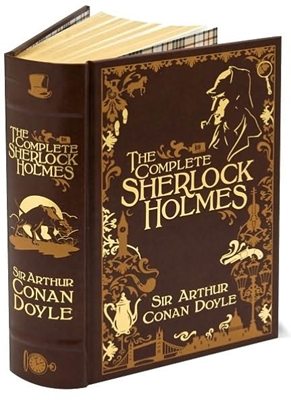
This book sits upon my desk at home, the ribbon bookmark ever changing. To say I like Sherlock Holmes is a bit of an understatement. I first came across his stories when I was a child, my first of his adventures being The Hounds of Baskervilles. I've read and re-read the stories many times, so many that as my first Escape Room adventure, we chose the Sherlock Holmes adventures over Edgar Allen Poe's (I also have The Complete Tales and Poems of Edgar Allen Poe, right next to Sherlock). If you had asked me why I like Sherlock Holmes when I was small, I was rather drawn in by detective stories. I read every Nancy Drew and Hardy Boys adventure story ever written, and then my grandmother told me about Sherlock. That dear readers, is all she wrote.

By the time we reached middle school, I questioned why the great sleuth wasn't taught in my particular English classes. I took great pains to hide my thick book under my desk, reading the stories when I was supposed to be focused elsewhere.

To go back a bit, I was ecstatic to discover that Sir Arthur Conan Doyle celebrated Edgar Allen Poe as being "the supreme original short story writer of all time" and I share his sentiment that once a great detective has been written, its hard to get away from that mold. Most detective stories I read now, all remind me in some ways of Sherlock, and by extension Dupin. As I mentioned, I read a lot of detective stories in my youth, and still read a lot more in my adult life, all of them bearing ties to the the great Detective and his Poe basis.

One of my favorite parts of Sherlock's stories, is that they are all written by Dr. Watson, and we see the world of Sherlock from his perspective. Dr. Watson is a very smart man in his own right, and Sherlock would not be Sherlock without his Dr. Watson. I start seeing this in how Watson begins to take life by the reins in his mission to figure out Sherlock, and the particular words Doyle chooses for Dr. Watson to describe and talk about Sherlock with (seized with a keen desire to see Holmes, he is certainly very conceited, how much this man stimulated my curiosity). Plus, the stories had to be written from Dr. Watson's perspective, otherwise they wouldn't be the approachable stories that they are. Imagine if all the stories were in Sherlock's perspective. It would be a bit like the BBC and Netflix series Sherlock. I wouldn't want to always have the thoughts in Sherlock's head narrating the story, always calculating and always analytical. It would ruin the mystery. Instead we follow Dr. Watson as Sherlock leads him to the end of the mystery. Plus it can't hurt that Sherlock even admits Dr. Watson chronicles their adventures better than he could.

'The ideas of my friend Watson, though limited, are exceedingly pertinacious. For a long time he has worried me to write an experience of my own. Perhaps I have rather invited this persecution, since I have often had occasion to point out to him how superficial are his own accounts and to accuse him of pandering to popular taste instead of confining himself rigidly to facts and figures. “Try it yourself, Holmes!” he has retorted, and I am compelled to admit that, having taken my pen in my hand, I do begin to realize that the matter must be presented in such a way as may interest the reader…' -Sherlock Holmes The Blanched Soldier

On talking about other works though, at some point we started seeing movies, and television series about Sherlock Holmes, the great detective. As a fan of Robert Downey Jr. I enjoyed his movies of Sherlock.I mean, what actor is better suited for the quirky detective? Who is brave enough to take on learning the disguising techniques?
Plus, who can't think of seeing Robert Downey Jr. in a dress?
The only discrepency I found with RDJ's Sherlock Holmes were that his disguises weren't quite as natural as is described in the book.

"Accustomed as I was to my friend's amazing powers
 in the use of disguises, I had to look three times 
before I was certain that it was indeed he."

 It's pretty easy to tell that Robert Downey Jr. is Robert Downey Jr., and the disguises certainly don't hold up to the imagery you get from Dr. Watson's words.

Then there's works such as the series Elementary, which I appreciate, and the Sherlock on BBC and Netflix, which I don't appreciate as much. But those, are best left for another post.

My only qualm with the two Sherlock stories we have read so far is at the end of A Scandal in Bohemia, I wanted to shake the King by the shoulders and shout something along the lines of "You shouldn't just be okay with her leaving with the picture! She still has it!" but I know it is all in the story. If not, we wouldn't have the run ins with Irene Adler later. She in my eyes, is a good foil for Sherlock, as she is what he could be if he exploited people the way she does. Instead, he chooses to thwart crime, solving puzzles no one else can solve. If not for his love of solving said puzzles, he would be a rather large threat to London and the greater European community with his powers of observation and deduction.

Much like Shakespeare's work, Sir Arthur Conan Doyle's Sherlock Holmes will definitely survive the ages, because really, who doesn't like a good puzzle to solve?

The Three Stories/Movies About Love

I thought the movies Warm Bodies and West Side Story were both interesting stories that had some parts from The Romeo and Juliet play/story, mostly in the West Side Story.  But, there was one important thing that I found that they all have in common, is the main plot and I guess the one message that each one had. That plot/message of all of them is that love has no boundaries and if two people can find love, then nothing can stop it, not even feuds between any two groups. Despite the different ways of the movies/stories were shown or played, they all seem to be a trend of telling and retelling the same story about love.  

In West Side Story, I liked it when the setting of the story was different from the R and J play/story. In this case, 1950’s New York U.S.A., and the feuding groups were two different ethic gangs, the Americans/Jets and the Portuguese/Sharks.  Since it was a musical, there was a lot of dancing which is just another form of expression through movement instead of poetical speech in R and J.  There were scenes of the movie that were like Romeo and Juliet like the dance scene where Tommy and Maria meet for the first time and the balcony scene were both meet again. Both movies had both scenes happen in the order it happened. I think that West Side story did well in having enough parts from the Romeo and Juliet movie and enough changes in the setting, the characters, and different ending.

In Warm Bodies, the setting was also different in a fictional, future, and apocalyptic world of two feuding sides of humans and zombies. The movie had the balcony scene with the two main characters R and Julie meet, though it happened towards the end of the movie compared to Romeo and Juliet where it happened towards the beginning.  The way the characters spoke also was more casual and not really any poetic speech nor lengthy dance scenes. That helped me get a better understanding on what was going on in the movie and I liked the happy ending that resolved the feuded compared to Romeo and Juliet where it had a sad ending and resolution to the feud. I also like the small bits of humor in the movie. If any one like bloopers as much as I do, I'd look at the bloopers for Warm Bodies. 


In my opinion, West Side Story was a good movie, even though I do have trouble liking musicals, I do appreciate the work and effort that goes into the dancing scenes. I liked Warm Bodies the most out of the three since the characters spoke the way I and most others around me would speak, which makes it easy for me to pay more attention and understand. There was no Shakespearean/poetic speak to stop and listen to carefully to understand what each character communicated to each other. Though I haven’t seen the Romeo and Juliet at a stage/play setting, after seeing all of three stories of love, I gained more understanding and appreciation for how love stories where and are now shown, played, and written. I would like to see different plays of the same story Romeo and Juliet and see the differences and similarities between them.